
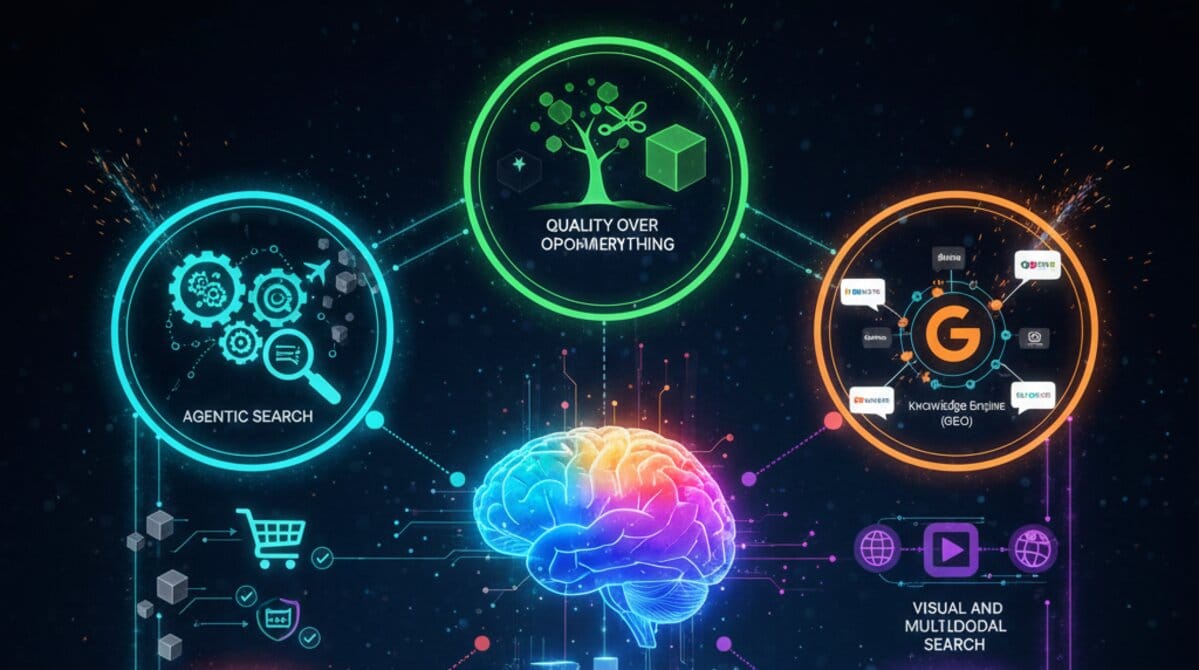
If you’ve spent any time looking at your search console data lately, you’ve probably noticed that the ground isn’t just shifting—it’s becoming liquid. We’ve officially entered 2026, and the enterprise SEO landscape feels a world away from where it was even eighteen months ago. It’s a bit overwhelming, isn’t it? Managing a site with hundreds of thousands of pages while search engines constantly overhaul their infrastructure is a daunting task for any digital marketer.
But here’s the thing: while the tools have changed, the goal remains to be the most helpful resource for your audience. It just takes a lot more heavy lifting behind the scenes now.
The Rise of Agentic Search and “Actionable” SEO
Remember when we just worried about keywords and backlinks? Now, we’re optimizing for agents. We are seeing a massive shift toward “Agentic AI”—tools like OpenAI’s Operator or Google’s advanced Jarvis-like prototypes that don’t just find information but actually complete tasks for users.
If you’re running a massive enterprise site, you have to ask yourself: is my content structured so a machine can actually use it to book a flight, compare a dozen software features, or troubleshoot a technical error? It’s no longer enough to just have a “how-to” guide. You need clean, robust schema and API-accessible data. If an AI agent can’t parse your pricing or availability instantly, it’s going to skip you and go to a competitor who made their data more “readable.” This is a stark shift in how we think about visibility, but it is precisely where the traffic is moving.
Quality Over Everything: The Death of Content Sprawl
We’ve all seen those enterprise sites with 50,000 blog posts that basically say the same thing. In 2026, that’s a death sentence. Google’s Search Generative Experience (SGE) and its evolved counterparts have become incredibly picky. They’re looking for “information gain.”
If your article is just a rehash of what’s already on the first page, why should a search engine care? I’ve noticed that the brands winning right now are the ones aggressively pruning their sites. They’re deleting low-value pages and focusing on deep, authoritative pieces that offer a unique perspective. It’s about being the definitive source. Think about your own habits; do you want five mediocre answers or one perfect one? Search engines are finally catching up to that human preference.
Generative Engine Optimization (GEO) is the New Reality
We used to call it SEO, but now many of us are pivoting toward GEO. This is the art of making sure your brand is mentioned—and mentioned accurately—inside the AI-generated summaries that now dominate the top of the fold.
How do you do that? It’s not about stuffing keywords anymore. It’s about brand citations and being part of the “knowledge graph.” Enterprise brands are finding success by leaning into digital PR and high-authority partnerships. When reputable industry sites talk about you, AI models take note. It’s as if old-school word-of-mouth has been digitized and scaled. If the “collective consciousness” of the internet thinks you’re the leader in enterprise cloud security, the AI will say so too.
This logic applies across the board, but it’s especially urgent for high-competition sectors like travel and hospitality. If you’re looking for a deep dive into how these principles are being applied in real-time, you should check out our recent piece on why GEO is now a non-negotiable for hotel marketing strategies. It highlights how moving beyond the search bar to prioritize AI-ready content is quickly becoming the only way to stay visible in an era of zero-click bookings.
Visual and Multimodal Search Takes Center Stage
It’s easy to forget that people don’t always search with words. With the ubiquity of Google Lens and similar tech integrated into every smartphone, visual search is a massive, often untapped, frontier for large companies.
Are your images optimized? I don’t just mean the alt text—though that’s still vital. I mean, are your product images high-res, original, and descriptive enough that an AI can identify exactly what they are in a split second? We’re seeing enterprises invest heavily in video SEO as well, because search engines are increasingly pulling specific “chapters” of videos directly into the search results to answer queries. If you haven’t started treating your video transcripts and metadata as seriously as your written content, you’re likely missing a significant revenue opportunity.
The Human-in-the-Loop Content Strategy
This might sound counter-intuitive given how much we’ve talked about AI, but the human element is actually more valuable than ever. Because the web is being flooded with “perfect” AI-generated text, it all starts to sound a bit… well, boring.
To stand out, you need a distinct voice. You need personal experience, case studies, and maybe even a few controversial opinions. This is what the search engines refer to as E-E-A-T (Experience, Expertise, Authoritativeness, and Trustworthiness). You can use AI to help you outline or research, but if a human doesn’t give the final product its soul, readers—and algorithms—will eventually sniff out the lack of authenticity. It’s a bit of a balancing act, trying to be efficient with AI while remaining stubbornly human.
So, where does your team stand? Are you leaning too hard into automation, or are you finding that sweet spot where tech meets genuine expertise? It’s a wild time to be in this industry, and I’d love to hear how you’re navigating these shifts. Drop a comment below or find us on Facebook, X (Twitter), or LinkedIn to share your thoughts on what’s working for your enterprise right now.
Sources:
- www.searchenginejournal.com/key-enterprise-seo-and-ai-trends-for-2026/558508/
- www.blog.google/products/google-cloud/ai-business-trends-report-2026/
- www.marketermilk.com/blog/seo-trends-2026
- www.moz.com/blog/2026-seo-trends-predictions-from-20-experts
- www.pwc.com/us/en/tech-effect/ai-analytics/ai-predictions.html

Exa AI Launches Exa Instant: Sub-200ms Search to Power the Agentic Era
Do You Still Need a Website in 2026? Google’s Search Team Weighs In