
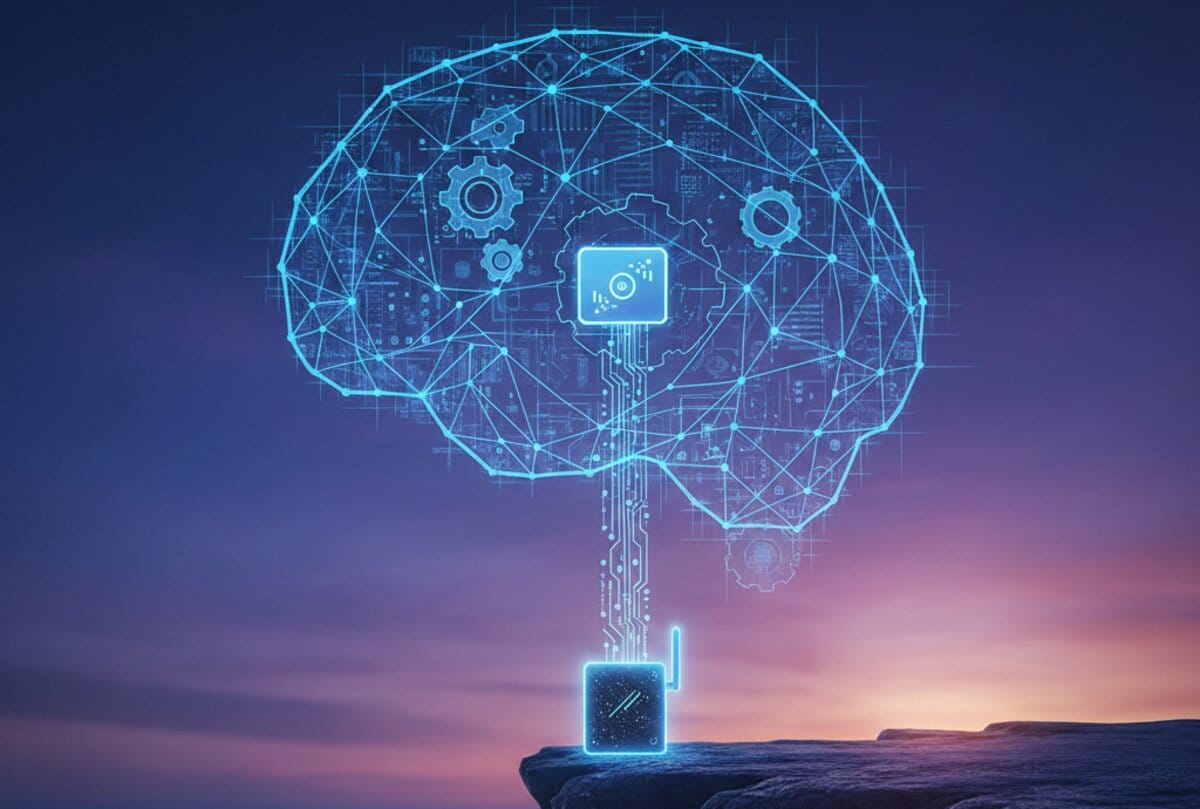
When you look at the sea of gadgets surrounding us today, it’s easy to think of the Internet of Things (IoT) as just a bunch of “connected” things. A smart fridge that tells you you’re out of milk, or a fitness tracker that counts your steps. But if you’ve been paying attention lately, you’ll notice the conversation has shifted. We aren’t just talking about devices that “talk” to the cloud anymore; we’re looking at hardware that actually thinks for itself. This is where IoT machine learning (ML) comes in. It’s the “brain” inside the “body” of the sensor. Without it, IoT is just a massive, noisy collection of data points that nobody has time to read. With it, your hardware becomes an autonomous agent capable of making decisions in milliseconds.
Key Takeaways
- The real action is happening at the “edge,” where machine learning models run directly on the device to ensure instant response times and better privacy.
- Beyond just monitoring, ML-enabled IoT now focuses on “predictive” health risks and machine failures weeks before they actually happen.
- Smarter Efficiency: New hardware like the Qualcomm Dragonwing and NVIDIA Jetson Thor are making it possible to run complex AI on tiny, low-power sensors.
Why the “Old Way” of IoT is Fading
For years, the standard approach was simple: the sensor collects data, sends it to a giant server in the cloud, the server crunches the numbers, and eventually, an alert pops up on your phone. It worked, mostly. But it was slow, expensive, and—let’s be honest—a bit of a privacy nightmare.
Think about a self-driving delivery bot or a high-speed industrial arm. If that machine has to wait for a signal to travel to a data center and back just to decide if it should stop, it’s already too late. You don’t want a safety system “buffering” while it tries to decide whether or not to hit something.
Today, we’re seeing a massive move toward “Edge AI.” Instead of being a passive node, the device uses local inference to handle the “Sense-Decide-Act” loop right then and there. It’s the reason a modern wearable can flag a heart arrhythmia the second it happens, even if you’re miles away from a Wi-Fi signal. It’s not just about speed; it’s about making the device reliable even when the internet goes dark.
The Architecture: How We Actually Fit a “Brain” into a Sensor
You might be wondering how on earth we cram a model that usually requires a room full of servers into a device the size of a postage stamp. It feels like trying to fit an elephant into a shoebox. The secret lies in a series of technical maneuvers that have finally matured.
Model Compression and Quantization
When an AI model is born in a lab, it’s “heavy.” It uses high-precision numbers that take up a lot of memory. To make it fit on an IoT device, developers use quantization. This essentially rounds off those complex numbers into simpler versions that a tiny processor can handle without losing too much “intelligence.”
Then there’s Pruning. Imagine a rose bush; you cut away the branches that aren’t blooming to help the rest of the plant thrive. Pruning removes the neurons in a neural network that aren’t contributing much to the final decision. The result is a lean, mean, decision-making machine that stays powered for ages instead of draining the battery in an hour.
Federated Learning
This is where things get really interesting for your privacy. In the past, to train a model, you had to send everyone’s private data to one central location. Federated learning flips this. The “learning” happens locally on your device. Only the tiny mathematical tweaks—the actual improvements to the logic, not your personal photos or messages—go back to the main server to update the master algorithm.
The Silicon Revolution: Hardware with a Purpose
You might wonder how a tiny sensor could possibly run a machine learning model. A couple of years ago, it couldn’t—not well, anyway. But the silicon has caught up. We are now seeing the rise of dedicated NPUs (Neural Processing Units) designed specifically for these tasks.
The hardware landscape has split into two fascinating directions. On one hand, you have high-performance edge nodes like the NVIDIA Jetson Thor, which are essentially supercomputers for robots. On the other, you have the rise of TinyML.
TinyML is the art of running machine learning on microcontrollers—the kind of chips that run your microwave or your electric toothbrush. These chips consume milliwatts of power but can now run keyword spotting or gesture recognition. It’s the difference between a device that’s just sitting there and one that’s actually “listening” for a specific cue.
Real-World Impact: More Than Just “Smart”
It’s easy to get lost in the tech specs, but the actual value of IoT machine learning is how it’s changing specific industries. It isn’t just “incremental improvement”—it’s a total rewrite of how things work.
1. Healthcare: From Tracking to Predicting
We used to be happy if our watch told us how many calories we burned. Now, devices are monitoring over 60 different biomarkers. By using machine learning to analyze “biometric drift” over months, these devices can predict cardiovascular risks years before you’d ever feel a symptom.
Take a modern continuous glucose monitor paired with an ML pump. It doesn’t just wait for a blood sugar spike; it actually tracks a person’s routine. It “knows” that on Tuesday mornings they usually go for a run, so it adjusts insulin levels before they even lace up their shoes. That’s not just a gadget; that’s a life-saving partner.
2. Manufacturing and “Digital Twins”
In a modern factory, every machine has a digital twin. This is a virtual “mirror” that lives in the system and receives real-time data from sensors. Machine learning models run simulations on these twins constantly.
If the ML notices a tiny vibration pattern in a turbine—a pattern so subtle a human ear could never hear it—it matches that “signature” to a bearing failure that might happen in three weeks. The system then just schedules a quick fix for 2 AM on a Tuesday when things are quiet. This “predictive maintenance” is moving the needle from “fixing things when they break” to “never letting them break in the first place.”
3. Smart Cities and Traffic Orchestration
We’ve all sat at a red light at 11 PM when there isn’t another car in sight. It’s frustrating and wasteful. IoT machine learning is finally fixing this through “Adaptive Traffic Control.”
Sensors at intersections aren’t just looking for a car to trip a wire; they are using computer vision to see the flow of the entire neighborhood. If a concert is letting out three blocks away, the lights coordinate to create a “green wave” to flush the traffic out of the city. It’s a living, breathing organism of infrastructure.
The Challenges (Because it’s Not All Magic)
I’d be lying if I said this was easy to implement. There are still some pretty big hurdles that keep engineers up at night.
Legacy Integration
You can’t just walk into a 30-year-old power plant and plug in a cutting-edge AI sensor. Most of the time, those old systems just aren’t built to share data in a way that modern AI can understand. Bridging that gap between “Old Iron” and “New Code” is a massive, expensive undertaking.
The Security Tightrope
With billions of connected devices, each one is a potential “front door” for a hacker. When you add machine learning to the mix, you introduce new types of attacks, like “adversarial machine learning.” This is where a hacker slightly alters the data going into a sensor to trick the AI into making a wrong decision. Think about a smart lock getting fooled because someone held up a specific pattern of paper that mimics a face. It’s a scary thought, and it’s why security has to be baked into the silicon, not added as an afterthought.
Data Quality (Garbage In, Garbage Out)
Machine learning is only as good as the data you feed it. If your IoT sensors are poorly calibrated or placed in high-interference areas, your ML model is going to make some very confident, very wrong decisions. Getting clean data from the messy physical world is a lot harder than pulling it from a organized database.
Energy Harvesting: The End of the Battery?
One of the most exciting shifts we’re seeing right now is the move toward “batteryless” IoT. Think about the waste generated by billions of lithium-ion batteries. It’s not sustainable.
Newer sensors are using energy harvesting—pulling power from solar, thermal gradients, or even the stray radio waves from your Wi-Fi router. Machine learning plays a crucial role here in “Power Budgeting.” The device actually learns the rhythm of its own energy source; if it knows the sun will be up soon, it might decide to crunch some heavy data now. If it’s running low, it scales back to the bare essentials. It’s like a survival instinct for electronics.
Moving Toward “Agentic” IoT
We are entering the era of the “Agent.” In the past, IoT was “Sense and Report.” Now, it’s “Sense, Reason, and Act.”
An autonomous drone inspecting a power line doesn’t just take photos for a human to look at later. It spots a frayed wire, calculates the risk right there on its own processor, and decides if it needs to circle back for a closer look. It is acting as an agent with a mission, not just a remote-controlled camera.
This shift requires us to rethink our relationship with our tools. We aren’t just users anymore; we’re supervisors.
How to Actually Get Started
If you’re looking to bring machine learning to your IoT projects, don’t try to build the “Matrix” on your first day. I’ve seen too many companies get paralyzed by the complexity.
- Identify a Single Friction Point: What is the one thing that, if predicted 10 minutes earlier, would save you the most money or headache?
- Audit Your Data: Do you actually have the data needed to train a model? If not, spend six months just collecting it before you even touch an ML framework.
- Start at the Edge: If possible, try to keep your processing local. It’ll save you a fortune in cloud storage fees and make your system much faster.
- Embrace the “Pivot”: Your first model will probably be wrong. That’s okay. Machine learning is an iterative process. You learn from the failures of the model just as much as the successes.
FAQ: Your IoT ML Questions Answered
Is traditional IoT connectivity still enough?
Honestly, probably not for most modern uses. If you need real-time responses or high levels of data privacy, relying solely on the cloud is becoming a bottleneck. You need some level of local intelligence to keep up with today’s demands.
What role does Edge Computing play in the long term?
It’s becoming the backbone. By 2026, we expect over half of all data analytics to happen at the “point of capture” (the device itself). It reduces bandwidth costs and makes systems much more resilient.
Are open standards like RISC-V actually important?
Very much so. They give developers more control over the hardware, allowing them to customize chips specifically for the machine learning tasks they need, without being locked into expensive, proprietary ecosystems.
What is “TinyML” exactly?
It’s a field of study in ML and embedded systems that explores the models, tools, and techniques capable of performing on-device sensor data analytics at extremely low power—typically in the milliwatt range. It enables “always-on” intelligence.
How do I secure an IoT device running ML?
It starts with a “Root of Trust” at the hardware level. You need to ensure the code running the model hasn’t been tampered with and that the data inputs are validated. Encrypting the model itself is also becoming standard practice to prevent “model theft.”
Wrapping Up
The marriage of IoT and Machine Learning isn’t just a trend; it’s the inevitable evolution of our digital world. We’re moving away from a world of “dumb” objects that just sit there and toward an environment that anticipates our needs, keeps us safe, and manages itself.
It’s a bit overwhelming, isn’t it? The idea that the light pole on the corner or the sensor in your shoe is “thinking.” But if we get the ethics and the security right, it’s a world that’s significantly more efficient and human-centric.
What do you think? Are you excited about the prospect of “Agentic” devices, or does the idea of autonomous sensors make you a bit uneasy? I’d love to hear your take in the comments. Let’s get a conversation going!
And if you’re wondering where all these “smart” sensors will point back to, you might want to check out this discussion on whether traditional web homes are still the goal in our increasingly decentralized world. Also, follow us on Facebook, X (Twitter), or LinkedIn for more guides and news.
Sources:
- www.cumulocity.com/resource-library/what-is-machine-learning-in-iot/
- www.smarttek.solutions/blog/iot-and-machine-learning/
- www.tech-stack.com/blog/applying-machine-learning-in-iot/
- www.saft.com/en/energizing-iot/iot-2026-four-trending-topics

What Does Wi-Fi Actually Mean? The Surprising Truth and How It Works
IoT Devices in 2026: Why the Future is Autonomous (Not Just Smart)