
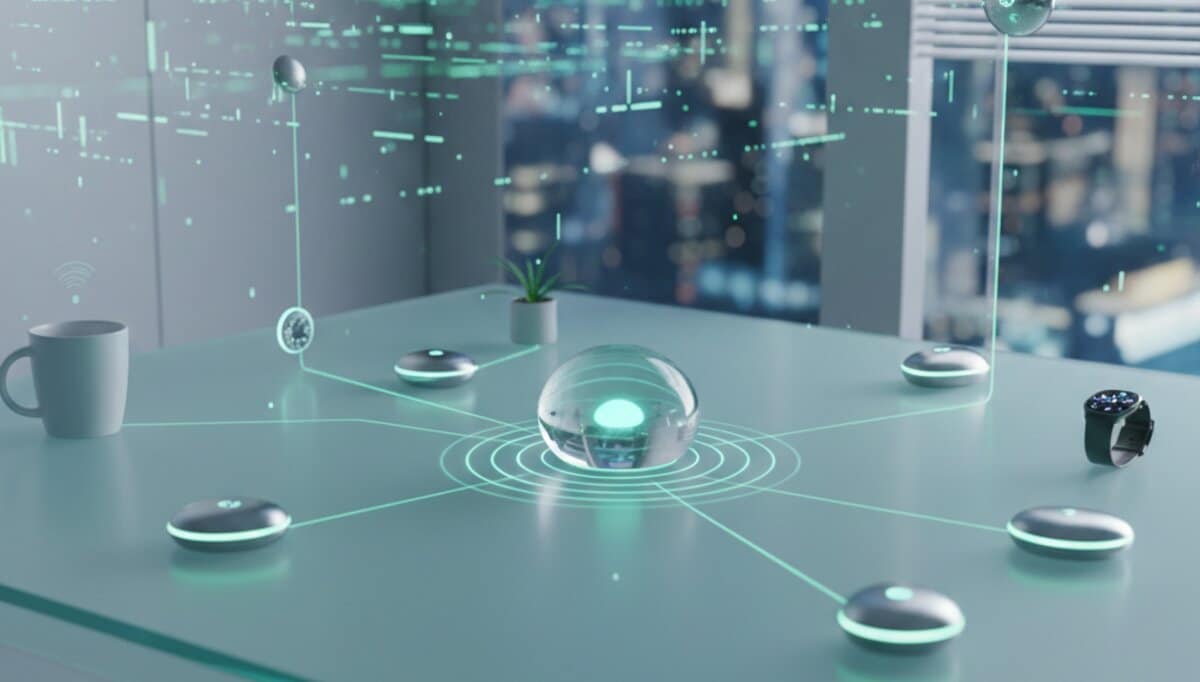
I was looking at an old smart plug the other day—a chunky, plastic block from maybe five or six years ago—and it hit me how much the world has changed. Back then, “IoT” felt like a collection of experiments. You’d buy a smart light, but it wouldn’t talk to your smart thermostat. You’d try to set up a camera, and it would drop the connection if your Wi-Fi dared to sneeze. Everything felt disconnected, like a bunch of gadgets living on their own separate islands. But if you look around now, that fragmentation is mostly a memory. We’ve entered a phase where Internet of Things devices are becoming the invisible nervous system of our physical world. They aren’t just gadgets we play with; they’re the infrastructure we rely on. Whether it’s the sensor in a grain silo tracking moisture or the ring on your finger telling you that you’re about to come down with a fever, these “things” are finally doing what they always promised: making life run smoother without us having to ask.
This is why the conversation is moving past simple connectivity. We’ve reached a point where even the most secure password is just one small piece of the puzzle, and as our devices get smarter, the way we protect them has to change entirely.
Key Takeaways
- Today’s Internet of Things devices are no longer just “connected” sensors; they are autonomous, AI-driven endpoints that utilize Edge Intelligence to process data locally rather than relying on the cloud.
- This transition drastically reduces latency, tightens security through Zero-Trust frameworks, and allows for real-time decision-making in critical areas like medical monitoring and industrial automation.
- With global standards like Matter and Thread finally unifying the market, the IoT ecosystem has moved from fragmented gadgets to a cohesive, invisible infrastructure that manages our homes and cities.
The Hardware Evolution: From Sensors to Brains
If you’re wondering why your devices are suddenly so much more responsive, it’s because the “brain” inside them has undergone a massive upgrade. We’ve moved away from simple microcontrollers and toward specialized Neural Processing Units (NPUs).
In the past, an IoT device was basically a messenger. It saw something, sent a data packet to a server in Virginia or Dublin, waited for the server to think, and then received an instruction. That’s why your smart lights sometimes had that annoying two-second delay. Today, we have Edge Intelligence. The device does the thinking itself. When a security camera with an NPU sees a person at your door, it doesn’t need the cloud to identify them. It knows it’s your neighbor because the facial recognition model is running right on the camera’s local hardware.
This change is about more than just speed—it’s about making these systems reliable when it matters most. In an industrial setting—say, an oil rig—a vibration sensor needs to detect a bearing failure in milliseconds to shut down a turbine before it explodes. It can’t wait for a round-trip to the cloud. By processing data at the “edge,” we’ve made Internet of Things devices more resilient and, frankly, a lot more useful in high-stakes environments.
The Smart Home Finally Speaks One Language
For a long time, the biggest headache with IoT was the “ecosystem war.” You had to check the box for a “Works with…” logo before you bought anything. It was exhausting.
The arrival and maturation of the Matter and Thread protocols have changed the game. Think of Matter as a universal language that lets a Philips Hue lightbulb talk to an Apple HomePod and a Google Nest thermostat without needing a dozen different hubs. Thread, on the other hand, is the mesh network that carries that language. Unlike Wi-Fi, which gets weaker the more devices you add, a Thread network actually gets stronger. Every plugged-in device—like a smart plug or a light switch—acts as a “router” for the signal, passing it along to the next device.
We’re now seeing “border routers” built directly into common household items like Wi-Fi routers and even smart TVs. This means your home’s IoT network is self-healing. If one device goes offline, the others just find a new path to keep the signal moving. It’s the kind of reliability we’ve been waiting for, and honestly, it’s about time.
Wearables and the “Quantified Self” 2.0
The wearable market has moved far beyond counting steps. I think we’re seeing a move from “fitness trackers” to “proactive health monitors.”
Take a look at the latest biosensors. They’re now capable of tracking things like blood glucose (non-invasively), hydration levels, and even stress via electrodermal activity—all from a device that looks like a regular watch or a discreet ring. But the real magic is the AI that sits behind that data. It’s no longer just telling you that you slept poorly; it’s analyzing your heart rate variability (HRV) and skin temperature to tell you that you should probably skip your workout today because your body is under too much strain.
In the healthcare sector, this has evolved into Remote Patient Monitoring (RPM). Doctors can now send patients home with IoT-enabled “hospital-at-home” kits. These devices—blood pressure cuffs, pulse oximeters, and ECG monitors—stream data directly to a medical dashboard. If a patient’s vitals dip below a certain threshold, an AI agent flags it for a human nurse to check in. It’s saving lives by catching complications before they become emergencies, and it’s keeping people out of crowded hospital wards.
Industrial IoT (IIoT): The Productivity Powerhouse
While smart homes get the most attention, the real heavy lifting is happening in factories, warehouses, and farms. This is the world of IIoT.
- Predictive Maintenance: This is probably the biggest ROI in the history of the industry. Instead of fixing a machine when it breaks (reactive) or fixing it on a set schedule (preventative), companies use IoT to fix it when it needs to be fixed. Sensors track microscopic heat changes or acoustic patterns that indicate a part is wearing out. Companies like Siemens and GE are seeing downtime reductions of up to 50% just by listening to what their machines are saying.
- Smart Agriculture: It’s almost strange to walk through a modern farm now. You’ll see soil sensors every few yards that measure nitrogen, pH, and moisture. These devices talk to autonomous irrigation systems that deliver exactly the right amount of water to specific zones. No more wasting water on a patch of land that’s already damp.
- Digital Twins: This is one of those concepts that sounds like sci-fi but is now standard practice. An IoT-enabled “Digital Twin” is a virtual replica of a physical asset. If you have a fleet of 500 delivery trucks, you have 500 digital twins. Every time a truck hits a pothole or its engine gets a little too hot, the digital twin updates. Managers can run “what-if” scenarios on the virtual model to see how the fleet would handle a 20% increase in load without risking the actual vehicles.
The Elephant in the Room: Security and Privacy
I can’t talk about billions of connected devices without talking about the risk. Let’s be honest: for years, IoT security was a joke. Manufacturers were so rushed to get products to market that they’d ship them with default passwords like “1234” and no way to update the software.
We’re finally seeing some adult supervision in the form of regulations like the EU’s Cyber Resilience Act. This law essentially says: “If you want to sell a connected device, it must be secure by design.” This means:
- No more default passwords. Every device must have a unique credential out of the box.
- Automatic updates. Manufacturers are now obligated to provide security patches for the reasonable lifetime of the product.
- Zero-Trust Architecture. This is a change in how devices talk to each other. Instead of a device trusting anything on the same Wi-Fi network, it now has to prove its identity every single time it tries to communicate.
There’s also a growing movement toward Data Sovereignty. People are rightfully wary of big tech companies knowing every time they open their fridge or go to bed. This is another area where Edge AI helps. If the voice processing for your smart assistant happens locally on the device—and the audio never leaves your house—the privacy risk drops significantly.
Energy Harvesting: The End of the Battery?
One of the biggest hurdles for large-scale IoT has always been the “battery problem.” If you have 10,000 sensors in a smart city, you can’t have someone going around changing batteries every year. It’s a logistical nightmare.
The solution we’re seeing take hold is Energy Harvesting. Modern IoT chips have become so incredibly efficient that they can run on almost nothing. Some devices are now “batteryless,” pulling tiny amounts of energy from the environment. This could be indoor light (via thin-film solar), temperature differences (thermoelectric), or even the stray RF signals from your Wi-Fi router.
Imagine a window sensor that never needs a battery because it gets enough energy from the sun hitting the glass, or a wearable that stays powered by your body heat. We aren’t quite there for high-power devices like cameras yet, but for the billions of simple sensors that make up a smart city, energy harvesting is the only way forward.
The Future: From “Smart” to “Autonomous”
As we look toward the next couple of years, the trend is moving away from “Smart” (a device that follows rules) and toward “Autonomous” (a device that makes decisions).
We’re starting to see Agentic AI integrated into IoT. An AI agent doesn’t just wait for you to say “turn on the lights.” It understands the context of your life. It knows that when you’re in your home office at 8:00 PM, you’re usually winding down, so it gradually shifts the lighting to warmer tones, adjusts the temperature, and silences non-essential notifications on your phone. It’s acting on your behalf by picking up on your habits, so you don’t have to spend your evening messing with settings or programming routines.
Common Questions Readers Are Asking (FAQ)
Are Internet of Things devices safe to have in my bedroom?
It’s a valid concern. If you’re worried about privacy, look for devices that mention “Local Processing” or “On-device AI.” This means the audio or video isn’t being streamed to a server for analysis. Also, ensure the device supports the Matter standard, as it includes more robust, modern security protocols.
Can I use IoT devices if my internet goes out?
Most modern smart home devices using Matter over Thread or Zigbee will continue to work locally even if your internet is down. You might lose the ability to control them via your phone when you’re away from home, but your light switches and automated routines should keep humming along.
What is the “Matter” standard I keep hearing about?
Think of Matter as the “USB” of the smart home. Just like you can plug any USB mouse into any computer, Matter allows devices from different brands (like Amazon, Apple, Google, and Samsung) to work together seamlessly on the same network.
How do I know if an IoT device is secure?
Look for a “Cyber Label” or mention of compliance with the EU Cyber Resilience Act or NIST standards. These indicate that the manufacturer has met baseline security requirements, such as no default passwords and a commitment to providing security updates.
Do Internet of Things devices use a lot of electricity?
Individually? No. Most sensors use less power than a tiny LED. However, if you have 50 devices, it can add up. The good news is that many newer devices use “Ultra-Low Power” (ULP) modes and energy-efficient protocols like Thread, which use significantly less power than traditional Wi-Fi gadgets.
Wrapping Up
It’s an exciting time to be watching this space. We’ve finally moved past the “gadget” phase and into something more meaningful. The Internet of Things is no longer about the internet or even really about “things”—it’s about the seamless way our physical environment is starting to respond to our needs.
If you’re interested in why we’re having to rethink security from the ground up in this new era, check out this deeper look at why passwords are becoming a relic of the past.
So, what about you? Are you embracing the fully connected life, or are you still a bit skeptical about having a “thinking” fridge? I’d love to hear your experiences—good or bad—with the smart tech in your life. Drop a comment below and let’s get a conversation going. And if you want to stay updated on how these technologies are evolving, make sure to follow us on Facebook, X (Twitter), or LinkedIn!
Sources:
- www.saft.com/en/energizing-iot/iot-2026-four-trending-topics
- www.techdogs.com/td-articles/techno-trends/top-iot-trends
- www.matteralpha.com/explainer/most-anticipated-matter-features-and-devices-in-2026
- www.iotevolutionworld.com/iot/articles/463180-aiot-2026-from-edge-intelligence-agentic-systems.htm

What Does Wi-Fi Actually Mean? The Surprising Truth and How It Works
IoT Machine Learning 2026: From Connected Sensors to Autonomous Agents