
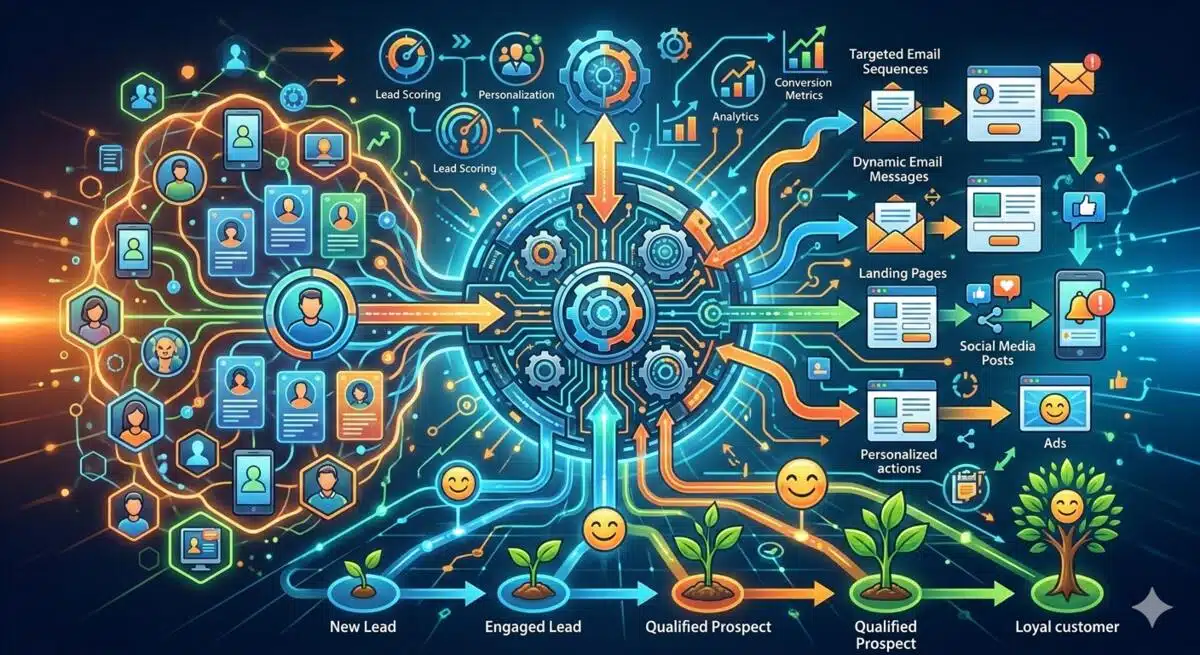
nd iIt’s a Tuesday afternoon, and you’re staring down a spreadsheet that’s already three weeks out of date. You know there are leads buried in those rows. You’re certain some of them clicked that “Request a Demo” button days ago, but between a flooded inbox, a cluttered calendar, and a half-configured CRM, things are just… a mess. We’ve all been there. It’s that nagging feeling that money is leaking out of the bucket because you simply can’t move fast enough to catch every hand that goes up.
If you’ve ever wondered why things feel so disconnected, sometimes the answer is hidden in the very tools we use every day—like how we often misunderstand the tech powering our offices. For instance, most people think “Wi-Fi” stands for “Wireless Fidelity,” but the truth is it’s a total marketing myth; the name was just a catchy play on “Hi-Fi” to make a complex technical standard feel friendly.
This is exactly why the conversation around CRM marketing automation has shifted from a “nice to have” for tech giants to a survival requirement for basically everyone else. We aren’t just talking about sending a “Thanks for subscribing” email anymore. We’re talking about building a system that actually knows your customers better than you do, or at least actually remembers them when it counts.
When you get this right, you stop being a digital firefighter and start being an architect. You move from reacting to every ping to building a machine that nurtures relationships while you sleep. But let’s be honest—it’s not as easy as just flipping a switch. It takes a bit of strategy, a dash of the right tech, and a real willingness to ditch those manual habits that are currently dragging you down.
Key Takeaways
- Integrated Synergy: CRM and marketing automation are no longer distinct silos; they form a unified engine where the CRM provides the historical memory and automation provides the active execution.
- Agentic AI Shift: The biggest trend in 2026 is the move from rigid “if-this-then-that” rules to autonomous AI agents that make real-time decisions based on predictive buyer intent.
- Revenue Growth: Businesses successfully merging these systems are seeing up to a 40% boost in productivity and significantly higher lead-to-customer conversion rates by eliminating manual data gaps.
The Great Divide: CRM vs. Marketing Automation
Before we dive into the deep end of how these things play together, we should probably clear up a bit of confusion. People often use these terms like they’re the same thing. They aren’t. Think of it like a professional kitchen. The CRM is your pantry and your recipe book—it’s where everything is stored, organized, and remembered. It’s the “system of record.” It tells you that John Doe bought a subscription three years ago, likes the color blue, and had a support ticket last month.
Marketing automation, on the other hand, is the chef. It’s the “system of action.” It’s what takes the ingredients from the CRM and actually does something with them. It sends the email, tracks the website click, scores the lead, and triggers the text message.
In the old days—which, let’s face it, was only a few years ago—these two lived in different worlds. Marketing would play with their automation tools to get leads, and then they’d “toss them over the wall” to the sales team, who lived in the CRM. The problem? That wall was usually made of thick, lead-plated glass. Sales had no idea what marketing had been doing, and marketing had no clue if their leads ever actually bought anything.
In 2026, that wall is officially gone. Or it should be. The goal now is a “closed-loop” system. You want your marketing tool to see that a customer just renewed their contract in the CRM, so it automatically stops sending them “New Customer” discount emails. It sounds simple, but you’d be surprised how many companies are still accidentally bugging their best clients because these two systems aren’t talking.
Why You Can’t Ignore the “Agentic” Shift
We have to talk about AI, but maybe not in the way you’re used to hearing it. For a long time, “automation” meant you had to manually build a giant, branching map of rules. “If they click this, wait two days, then send that.” It was exhausting to build and even harder to maintain.
The big change we’re seeing right now is the rise of Agentic AI. Instead of you telling the system exactly what to do at every step, you give it a goal. You might tell your system, “I want to maximize renewals for our enterprise clients this quarter.” The AI then looks at the data in your CRM—things like product usage, support tickets, and even the “sentiment” in their recent emails—and decides the best move. Maybe it sends a personal note, or maybe it pokes a sales rep to give them a call because the customer looks like they’re about to churn.
It’s a bit scary to let go of the reins, I know. But the reality is that buyers in 2026 have zero patience for generic, poorly timed outreach. They expect hyper-personalization. They want you to know that they just read your blog post on “Scalable Infrastructure” and that they’re likely looking for an upgrade. If your automation can’t react to that in minutes, your competitor’s automation definitely will.
Building the Foundation Without Losing Your Mind
If you’re starting from scratch, or if your current setup feels like a house of cards, where do you actually begin? It’s tempting to go out and buy the most expensive platform on the market and hope for the best. Don’t do that. That’s a fast track to a very expensive headache.
The first step isn’t technical; it’s cultural. You have to get your sales and marketing teams in the same room—physically or virtually—and agree on what a “good lead” actually looks like. In the industry, we call this Lead Scoring, but you can just think of it as a “Hotness Meter.”
Maybe a lead gets 10 points for downloading a whitepaper, 20 points for visiting your pricing page, and 50 points if they attend a live webinar. Once they hit 100 points, the automation shouldn’t just send another email; it should automatically create a “Task” in the CRM for a human to reach out.
This is the “Handoff,” and it’s where most companies fail. If that lead sits in the CRM for three days before a salesperson sees it, the whole automation was basically for nothing.
Real Examples of Synergy in Action
Let’s look at how this actually plays out in the real world. Imagine you run a SaaS company. A user signs up for a free trial.
- The Trigger: As soon as they sign up, your marketing automation tool catches the new entry in the CRM.
- The Nurture: Over the next 14 days, the automation sends a series of “How-to” videos. But here’s the kicker: it’s tracking which features they actually use. If they haven’t set up their dashboard yet, it sends a specific email about the dashboard. If they have set it up, it just skips that and moves to the next advanced feature.
- The Alert: On day 10, the user visits your “Enterprise Pricing” page three times in one hour. The system recognizes this as a clear “intent signal.”
- The Human Touch: Instead of another automated email, the system pings a sales rep on Slack: “Hey, John from Acme Corp is looking at the Enterprise page right now. Here is his LinkedIn profile and a summary of his trial usage.”
That is CRM marketing automation done right. It’s not about replacing humans; it’s about making sure humans show up at the exact moment they’re actually needed.
The 2026 Tech Landscape: Which Tool is Your Type?
There’s no shortage of options out there, and the “best” one depends entirely on how big you are and how much complexity you can handle.
If you want everything under one roof, HubSpot is still the heavyweight champ for a reason. They’ve spent years making sure their CRM and their marketing tools feel like they were actually built to work together (because they were). It’s great for mid-market companies that want to hit the ground running without needing a full-time developer just to keep the lights on.
On the other end, you have Salesforce. It’s the “Lego set” of the CRM world. You can build literally anything with it, but you’re going to need someone who knows what they’re doing to put the pieces together. For massive enterprises with complex, multi-layered sales cycles, it’s often the only choice that can handle the weight.
Then there are the “Automation-First” players like ActiveCampaign. These tools are fantastic if your primary goal is sophisticated, logic-heavy email and SMS flows. They might not have the raw database power of a Salesforce, but their workflow builders are often way more intuitive for the average marketer.
And let’s not forget the “Composable” approach. Maybe you use Pipedrive for your sales team because they love the visual pipeline, but you use Klaviyo for your automation because you’re in e-commerce. In 2026, tools like Zapier or Make have become so advanced that connecting these “best-of-breed” tools is easier than it’s ever been. You don’t necessarily have to buy a “Suite” if you’d rather build your own “Stack.”
The Messy Reality: Data Hygiene and Privacy
I’d be doing you a disservice if I didn’t mention the “D” word: Data. Your automation is only as smart as the information you give it. If your CRM is full of duplicate entries, “Test Test” emails, and outdated job titles, your automation is going to make you look like a fool.
In 2026, we also have to deal with a much stricter privacy environment. People are tired of being tracked across the web, and regulations have caught up. This means you can’t rely as much on “third-party cookies” to tell you what people are doing. You have to rely on “First-Party Data”—the stuff they actually tell you or do on your own properties.
This makes your CRM even more valuable. It’s the one place where you own the relationship. Successful companies this year are focusing on “Value-Exchange.” If you want a customer’s data, you have to give them something genuinely useful in return. No more gated content that turns out to be a flimsy two-page PDF.
Common Pitfalls (And How to Side-Step Them)
Why do so many companies spend six figures on these systems only to end up back in their spreadsheets six months later?
Usually, it’s because they tried to automate a broken process. Automation is essentially a magnifying glass. If you have a great sales process, automation makes it legendary. If you have a confusing, clunky sales process, automation just makes you confuse more people, faster.
Another big mistake is “Set it and Forget it” syndrome. You build a beautiful 20-step welcome sequence in January, and by December, half the links are broken and the “limited time offer” expired six months ago. You have to treat your automation like a garden. It needs weeding. It needs pruning. You should be looking at your “Win Rates” and “Engagement Metrics” at least once a month to see where people are falling out of the funnel.
Is It Worth the Effort?
Honestly? Yes. But only if you’re willing to put in the work upfront. The “productivity gains” everyone talks about—like that 40% jump projected by firms like McKinsey—don’t come from the software itself. They come from the fact that your team stops doing “busy work.”
When your CRM is automatically capturing every email, every meeting, and every website visit, your sales reps don’t have to spend Friday afternoon “updating the system.” They can spend it actually talking to people. When your marketing team can see exactly which campaigns led to actual revenue (not just “likes” or “opens”), they can stop wasting budget on stuff that doesn’t work.
It’s about clarity. It’s about knowing that when a lead comes in, there’s a system in place to catch them. At’s about being able to scale your business without watching your stress levels skyrocket at the same time.
Frequently Asked Questions
What is the main difference between CRM and marketing automation?
Basically, a CRM is a database for managing relationships and sales pipelines (the “who”), while marketing automation is a tool for executing and scaling marketing campaigns like email, SMS, and lead nurturing (the “how”). The CRM is the memory, and the automation is the engine. They work best when they share a single pool of data.
Does a CRM include marketing automation automatically?
Not always, though the lines are blurring fast in 2026. Some “all-in-one” platforms like HubSpot or Zoho have both built-in. Others, like Salesforce, often require a separate (but integrated) module like Marketing Cloud. Many smaller CRMs focus purely on sales and require you to connect a third-party tool for the automation side.
How does CRM marketing automation improve the customer experience?
It prevents those “embarrassing” moments where you send a sales pitch to someone who just complained to your support team, or a “Welcome” email to someone who has been a customer for five years. By sharing data, you can ensure your messaging matches where the customer actually is in their journey, making your brand feel more attentive and way less robotic.
Is it difficult for a small business to implement this?
It used to be, but not anymore. With no-code tools and “lite” versions of major platforms, you can set up basic automation in a weekend. The difficulty isn’t usually the tech; it’s the strategy. You need to know what your “ideal path” for a customer looks like before you can tell a machine to follow it.
How is AI changing CRM automation right now?
We’re moving into the era of “Agentic AI.” Instead of just following “if-this-then-that” rules, AI can now analyze “intent signals”—like how long someone hovered over a pricing plan—and decide on its own whether to send an email, offer a discount, or alert a sales rep. It’s becoming much more proactive and predictive.
Wrapping Up
The world of CRM marketing automation can feel like a lot to take in, especially with how fast things are moving this year. But at the end of the day, it’s just about being more human at scale. It’s about making sure no one gets forgotten and every interaction feels like it actually matters.
What’s your biggest “headache” when it comes to managing your leads right now? Is it the data entry, the handoff to sales, or just finding the right tool? Drop a comment below and let’s talk about it. We’d love to hear what’s working (and what isn’t) in your world.
And if you found this guide helpful, don’t forget to follow us on Facebook, X (Twitter), or LinkedIn for more deep dives into the tech that’s actually making a difference in 2026.
Sources
- www.hubspot.com/marketing-statistics
- www.klaviyo.com/blog/marketing-automation-trends
- www.destinationcrm.com/Articles/CRM-Insights/Insight/A-Look-Ahead-at-CRM-in-2026-173336.aspx
- www.siroccogroup.com/2026-crm-trends-twelve-practical-shifts-for-revenue-operations/

The Industrialization of Fraud: How to Stay Secure in a Deepfake World
7 Best Small Business Marketing Apps to Save Time and Boost Sales