
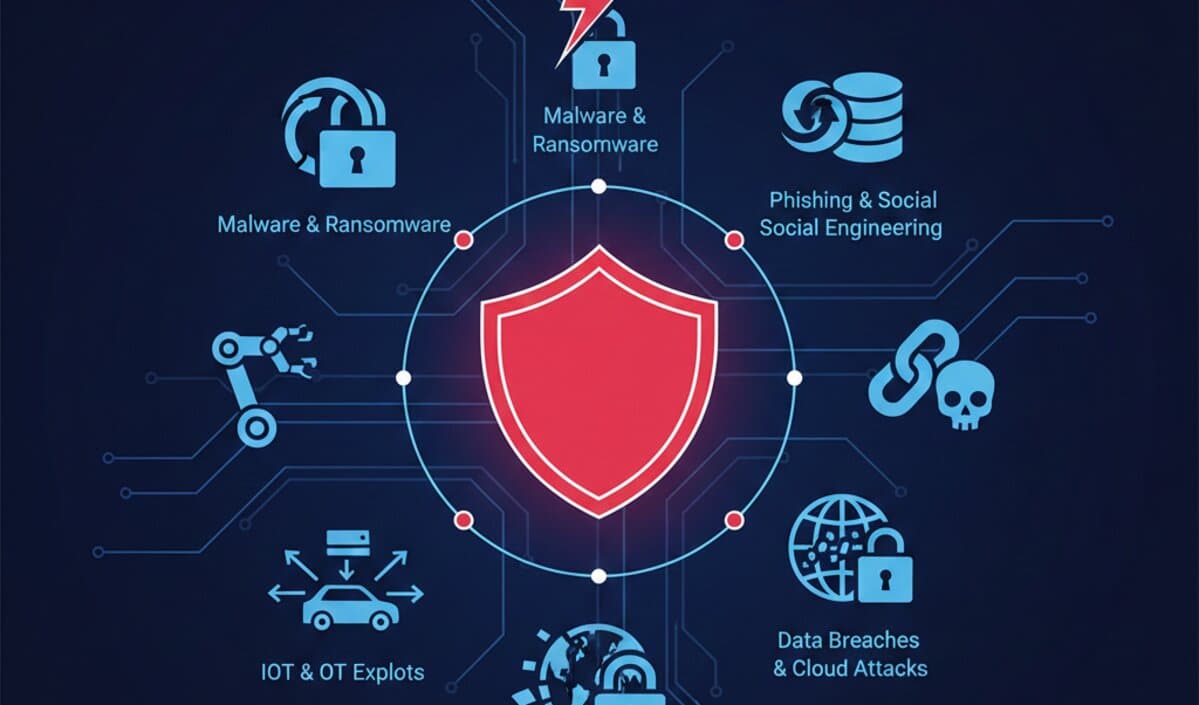
It’s a strange time to be online. If you look back just a few years, cybersecurity felt like a technical problem—something for the IT department to handle with a good firewall and some antivirus software. But lately, it’s started to feel a lot more personal and, if I’m being honest, a bit exhausting. We’ve moved past the era of those “Nigerian Prince” emails into a world where an attacker might spend weeks studying your LinkedIn profile or your company’s public financial reports before they ever even reach out. The reality of 2026 is that the many types of cyber attacks aren’t just a list of definitions anymore. They are overlapping, evolving strategies. An attacker might start with a clever social engineering lure, pivot to stealing your credentials, and end with a full-blown ransomware deployment.
To stay safe, you need to understand not just what these attacks are called, but how they’ve changed the way we have to think about our digital lives.
Key Takeaways
- Cyber threats have transitioned from mass-market “spray and pray” tactics to hyper-personalized, AI-augmented operations that exploit human psychology and supply chain interdependencies.
- The rise of “Cybersecurity-as-a-Service” has lowered the barrier for entry, allowing low-skilled attackers to deploy sophisticated ransomware and extortion schemes.
- Defense strategies are pivoting toward resilience and “Blast Radius” containment, recognizing that prevention alone is no longer a guaranteed shield against modern exploits.
The Sophistication of Human-Centric Attacks
We often think of hacking as a technical exploit—finding a bug in code. But the most effective “bug” has always been human nature. In 2026, social engineering isn’t just a component; it’s the engine driving most successful breaches.
The Precision of Spear Phishing and “Whaling”
You’ve likely heard of phishing, but have you considered how narrow the target has become? Standard phishing is like casting a huge net into the ocean and hoping for a bite. Spear Phishing, though, is more like a harpoon. Attackers are now using Generative AI to scrape your public data—your recent conference appearances, the “welcome” posts you write for new hires, even the specific way you word your social media updates.
They use this info to craft emails that don’t just look real; they actually feel real. If you’re a high-level executive, you’re a target for Whaling. These attacks are designed to look like legal subpoenas, executive board memos, or sensitive HR complaints. When the stakes feel that high, your gut instinct is to click and fix it right away. That’s exactly what they’re counting on.
The Rise of Deepfake Social Engineering
This is where things get truly unsettling. We’ve moved beyond static images. Vishing (voice phishing) and Quishing (QR code phishing) have been joined by live video and audio deepfakes.
Imagine you’re on a standard Microsoft Teams call. A colleague’s face pops up, their voice sounds exactly right, and they ask you to share your screen to “help with a quick technical issue.” In reality, you’re talking to a real-time AI overlay. This isn’t science fiction; we saw a massive version of this play out in the Ferrari deepfake attempt recently, where an attacker tried to impersonate the CEO to authorize a deal. It only fell through because the person on the other end noticed a tiny slip-up in the “CEO’s” vocabulary. Could you say you’d be that observant on a busy Tuesday morning?
The Silent Network: Your Home’s Growing Attack Surface
While we worry about the emails in our inbox, we often overlook the silent gadgets surrounding us. In 2026, the perimeter of your “digital life” has expanded far beyond your laptop. From smart thermostats to connected security cameras, the Internet of Things (IoT) has woven a web of convenience that attackers view as a massive web of opportunity. Every connected device is a potential entry point that doesn’t have a human sitting behind it to spot a phishing attempt.
The danger isn’t just about someone “hacking your toaster” for a laugh; it’s about these devices serving as a quiet bridge into your home network. Most people don’t realize that how IoT impacts your daily routine is directly tied to your personal security posture. A compromised smart bulb can be the first step an attacker takes to move laterally into the laptop you use for work, turning your “smart home” into a collaborator in a data breach.
The Industrialization of Ransomware
If you think ransomware is still just about getting a “locked” screen on your computer, I have some bad news. The business model has shifted. We are now firmly in the era of Ransomware-as-a-Service (RaaS).
The Triple Extortion Threat
The old “pay to get your files back” model is largely dead because most smart companies now have robust, immutable backups. To counter this, attackers developed Triple Extortion:
- Encryption: They lock your systems.
- Data Theft (Exfiltration): They steal your data and threaten to leak it if you don’t pay. This is the “Double Extortion” we’ve lived with for a while.
- The Third Strike: They target your stakeholders. If they steal a hospital’s data, they don’t just go after the hospital; they send individual emails to the patients, threatening to release their private medical records unless they pay a separate fee.
This creates a level of pressure that is almost impossible to ignore. It effectively turns your own customers or clients against you.
Modern Targets: The Infrastructure and the Supply Chain
The 2025 attack on UnitedHealth Group’s Change Healthcare was a wake-up call for everyone. It didn’t just hurt one company; it paralyzed the ability of pharmacies across the U.S. to process prescriptions. This is what modern attackers are looking for: the “choke point.”
By attacking a single software provider or a critical infrastructure node, they can cause a “cascading failure.” This brings us to Supply Chain Attacks. When you use a third-party tool—whether it’s for payroll or CRM—you’re basically extending your security perimeter to include them. If they get hit, you get hit. The SolarWinds and Kaseya attacks of years past were the blueprints, and today’s hackers have perfected the craft.
The Technical Side: Exploit Trends
While the “human” side is booming, the technical methods used to gain that first foothold are becoming more automated and harder to detect.
Zero-Day Exploits and “Living off the Land”
A Zero-Day is a vulnerability that the software creator doesn’t even know about yet. In the past, these were rare and expensive. Today, there’s a thriving underground market for them.
Once an attacker is inside, they often use a technique called Living off the Land (LotL). Instead of installing obvious malware that an antivirus might flag, they use the computer’s own legitimate tools—like PowerShell—to carry out their work. To your security system, it looks like a normal IT admin is just doing their job. It’s the digital equivalent of a burglar wearing a maintenance uniform and using the building’s own master keys.
The Invisible Thief: Formjacking
You’re shopping online, the site looks secure, and there’s a little padlock in the URL bar. You enter your credit card info. Everything seems fine. But in the background, a tiny bit of malicious JavaScript—tucked away by a hacker who compromised the site’s code—is copying your card details and sending them to a server in another country.
This is Formjacking (a type of Magecart attack). It’s incredibly hard for the average person to spot because the website functions exactly as it should. It’s not until you see weird charges on your statement three weeks later that you realize something went wrong.
Emerging Threats: What’s on the Horizon?
As we look further into 2026, two major technological shifts are starting to change the “attack surface” of our world.
AI Poisoning and Model Theft
As more companies integrate AI into their daily operations, a new type of threat has emerged: Adversarial Machine Learning. Attackers can “poison” the data used to train an AI. For example, if a bank uses AI to detect fraud, an attacker might subtly feed that AI “clean” data that actually contains fraudulent patterns. Over time, the AI learns that these specific crimes are “normal,” allowing the attacker to bypass the system entirely.
The Quantum Shadow
We aren’t quite at the point where quantum computers can break all modern encryption, but the threat is already here. It’s called “Harvest Now, Decrypt Later.” Attackers are stealing massive amounts of encrypted data today, even if they can’t read a single line of it yet. They’re betting that in a few years, quantum technology will allow them to unlock it. If that data includes long-term secrets—like government documents or trade secrets—the damage is already done.
Frequently Asked Questions
Why is my small business a target? I don’t have much money.
Actually, small businesses are often preferred targets. Attackers know you likely don’t have a security team working around the clock. They can automate the attack on 1,000 small businesses much more easily than they can breach one Tier-1 bank. Plus, you might be a “backdoor” into a larger partner you work with.
Is Public Wi-Fi really that dangerous?
It’s less about “someone seeing your screen” and more about Man-in-the-Middle (MitM) attacks. An attacker can set up a fake hotspot with the same name as the airport or coffee shop. Once you connect, they can see everything you’re doing. Always use a VPN or, better yet, your phone’s cellular data.
How do I know if my password has been stolen?
Services like “Have I Been Pwned” are great for checking if your email was part of a known breach. But a better habit is just using a Password Manager. If you use a unique, complex password for every site, a leak at one place won’t compromise your entire life.
Are “Passkeys” better than passwords?
Yes, by a long shot. Passkeys use your device’s local authentication (like a fingerprint or FaceID) to log you in. Since there’s no “password” stored on a server for a hacker to steal, it effectively kills the most common way people get hacked. If a site offers Passkeys, take them up on it.
Living with the Risk: A Practical Mindset
I’m not telling you all this to make you want to throw your laptop in the ocean and move to a cabin in the woods. The digital world is too useful for that. But you have to move away from the idea of being “unhackable.”
The goal now is Resilience.
- Segment your data: Don’t keep everything in one giant folder.
- Audit your permissions: Does that “Flashlight App” really need access to your contacts and location? (The answer is always no).
- Test your backups: A backup you haven’t tried to restore is just a file you’re hoping works.
Cybersecurity is really just a game of friction. You don’t have to be perfect; you just have to be a harder target than the person next to you. By implementing things like MFA, staying skeptical of “urgent” emails, and keeping your software updated, you’re already ahead of 90% of the population.
The landscape will keep shifting—AI will get smarter, and attackers will find new cracks in the sidewalk. But if you understand the “why” and “how” behind these attacks, you’re much less likely to be the one paying for a hacker’s next vacation.
What’s your biggest worry when it comes to your online security? Is it your bank account, your private photos, or something else entirely? Let’s start a conversation in the comments below. And don’t forget to follow us on Facebook, X (Twitter), or LinkedIn for real-time updates on new threats as they emerge!
Sources:
- www.onlinedegrees.sandiego.edu/top-cyber-security-threats/
- www.cyberthreatalliance.org/threats-and-cyber-attacks-in-2026/
- www.cobalt.io/blog/top-cybersecurity-statistics-for-2026
- www.insights.integrity360.com/the-biggest-cyber-attacks-of-2025-and-what-they-mean-for-2026
- www.research.checkpoint.com/2026/cyber-security-report-2026/

Top Tools Offering Advanced Real-Time Threat Detection in 2026
Add Tip or Charity Contribution on Product Pages