
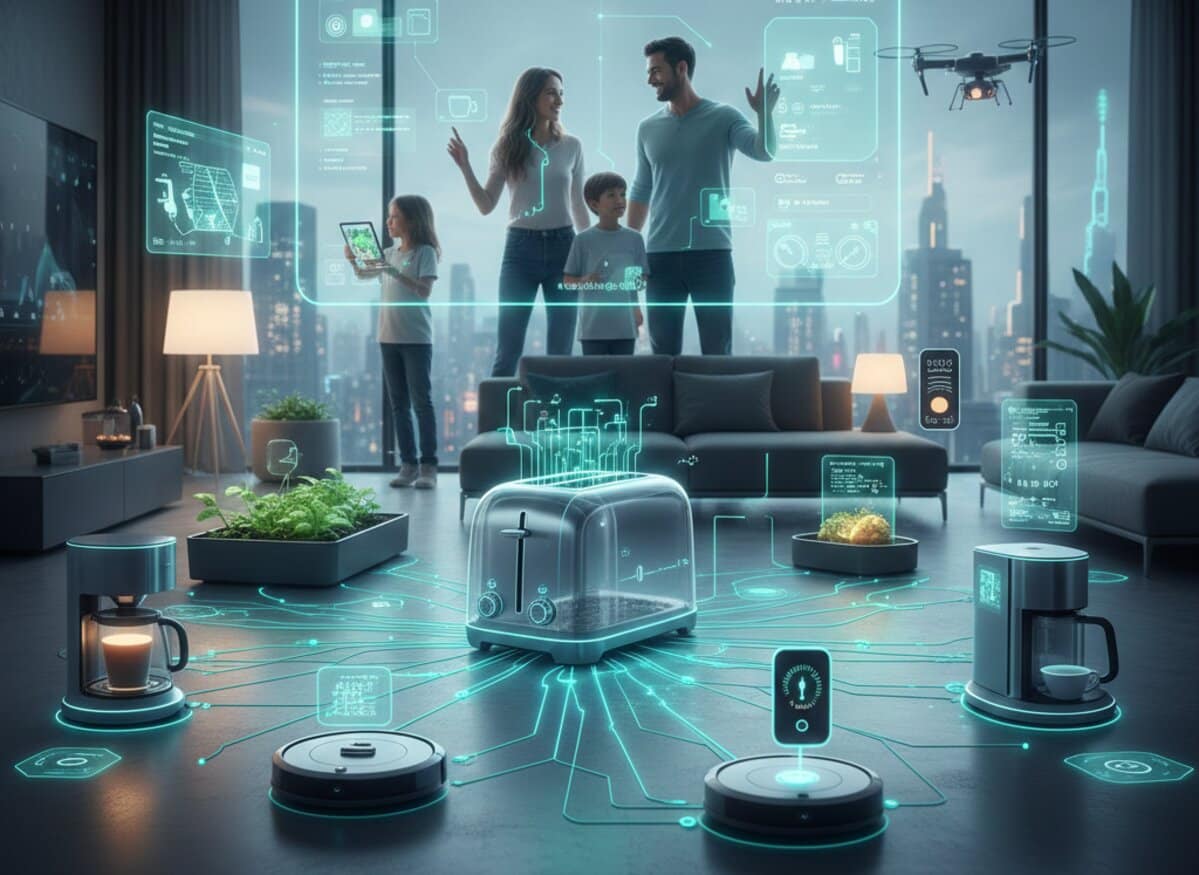
The digital landscape isn’t just a place we visit anymore; it’s the very air our gadgets breathe. You’ve likely heard the term “IoT” or “Internet of Things” tossed around in tech circles or seen it slapped onto the box of a new “smart” toaster. But what does it actually mean for you in your daily life, and why is everyone suddenly obsessed with the “edge” and “interoperability”? It’s a lot to untangle, but once you see the patterns, the “magic” starts to look more like a massive, logical web.
Key Takeaways
- IoT is a massive network of physical objects—from watches to industrial drills—that use sensors and software to “talk” to each other and make autonomous decisions without needing a human to middle-man the conversation.
- We’ve moved past simple cloud connectivity; the current focus is on Edge AI, where devices process data locally to save time, reduce bandwidth costs, and keep your private data off remote servers whenever possible.
- This evolution is turning cities into responsive ecosystems and healthcare into a proactive, wearable-driven field that can predict a cardiac event or a blood sugar spike before you feel a single symptom.
What is IoT?
At its simplest, IoT is about giving “dumb” objects a voice. Think about your old-school coffee maker. It sat there, oblivious to the world, until you pushed a button. An IoT-enabled version, however, knows when you’ve stepped out of bed because your mattress sent it a signal. It knows you’re low on beans because it weighed the hopper. It isn’t just “connected”; it’s aware.
This awareness comes from three main pillars working in tandem:
- Sensors and Actuators: These are the “eyes, ears, and hands.” Sensors pick up temperature, light, motion, or air quality. Actuators do the physical work—turning a valve, locking a door, or dimming a bulb.
- Connectivity: The “nervous system.” This is how the data moves. While Wi-Fi is the old standby, we’re seeing a massive move toward Matter, a protocol that finally lets Apple, Google, and Amazon devices talk to each other without a fight.
- Data Processing: The “brain.” This is where the device decides what to do with the info.
For years, that “brain” lived in the cloud—massive servers owned by big tech companies. But lately, things have shifted. You might have noticed your devices reacting faster than they used to. That’s because of Edge Computing. Instead of sending data on a long round trip to a server halfway across the country, the device handles the heavy lifting right there on its own hardware. It’s the difference between a smoke detector that has to “ask” the internet if there’s a fire and one that just sounds the alarm because it knows.
This same logic applies to how we interact with products online. For instance, if you’re shopping for these smart gadgets, you expect a seamless experience. Just as sensors give a device “eyes,” features that allow you to zoom in on product images with a simple hover give you the clarity needed to inspect the hardware before you buy.
The “Real World” Impact: It’s Not Just About Toasters
It’s easy to get stuck thinking IoT is just about dimming your lights with your voice or checking if you left the oven on. But the real heavy lifting is happening in places you might never see.
The Industrial Backbone
In massive factories, machines are now equipped with something called “Digital Twins.” These are virtual replicas that mirror the physical machine in real-time. If a bearing in a real-world turbine starts to vibrate at an odd frequency, the Digital Twin spots it. The system then schedules maintenance before the machine breaks.
People often call this “predictive maintenance.” It might sound like typical corporate jargon, but it’s a total game-changer on the ground. It’s the difference between a power plant going offline for a week and a technician swapping out a $50 part during a scheduled 20-minute break.
Agriculture and the “Connected Farm”
Farmers are using IoT to survive increasingly unpredictable weather. Sensors buried in the soil tell the irrigation system exactly how much water is needed at the root level. Drones equipped with multispectral cameras fly over crops to spot pests or nitrogen deficiencies before the human eye can see them. It’s precision on a scale that was impossible twenty years ago.
Health on Your Sleeve (Literally)
We’ve moved far beyond counting steps or checking how well you slept. Modern wearables are becoming miniature clinics. There are now smart patches that monitor glucose levels without a single needle prick and sensor-embedded clothing that can track your posture or hydration.
The goal isn’t just to show you a graph on your phone. It’s about remote patient monitoring. Imagine an elderly relative living alone; IoT sensors can detect a “fall pattern” or a change in gait and alert emergency services immediately. It provides a safety net that doesn’t feel like a surveillance camera.
The Friction: Privacy, Security, and the “Ghost in the Machine”
I’ll be honest with you: the more “things” we connect, the more “doors” we leave unlocked for hackers. It’s a bit of a Wild West situation. In the rush to get the latest smart gadget to market, some manufacturers treat security as an afterthought.
You might wonder, “Who cares if someone hacks my smart fridge?” Well, the fridge itself isn’t the prize. The prize is your home network. Once a hacker gets into that fridge, they can often jump to your laptop, your phone, or your work-from-home setup.
The industry is finally starting to get its act together. New regulations are forcing companies to build security into the hardware itself—a concept called Security by Design. We’re also seeing a rise in “Zero Trust” models, where devices have to constantly prove who they are before they’re allowed to talk to the rest of the network. It’s a bit of a hassle to set up, sure, but in a world with billions of connected devices, it’s a necessity.
And then there’s the privacy aspect. If your smart bed knows when you’re sleeping, and your smart fridge knows what you’re eating, who else knows? The data “exhaust” we create is incredibly valuable to advertisers. As a user, you have to decide where your personal line in the sand is.
Why Should You Care?
You might feel like you can opt-out of this connected world, but it’s becoming increasingly difficult. IoT is no longer a “tech feature”; it’s the infrastructure of modern life. It’s how your power grid balances itself when everyone turns on their AC at 5:00 PM. It’s how your package gets from a warehouse in another country to your doorstep in 24 hours.
The real value isn’t in the gadgets themselves, but in the data they produce. This data allows us to be more efficient, more sustainable, and—ideally—healthier. But it also requires us to be more vigilant about our digital footprints.
A Quick Tip: If you’re buying new smart home gear, look for the “Matter” logo. It’s a universal standard that ensures different brands actually play nice together and meet a certain baseline for security. It saves you from having fifteen different apps for fifteen different lightbulbs.
The Future: Toward an “Internet of Everything”
Where is this all going? We’re moving toward a state where the “Internet” part of IoT fades into the background. It will just be how things work. We’ll see more Ambient Intelligence, where environments respond to your presence without you having to issue a command.
Imagine walking into an office building that already knows which desk you’ve reserved, adjusts the chair height to your preference, and sets the lighting based on your circadian rhythm. It sounds like sci-fi, but the sensors are already being installed.
The challenge for us—the humans in the loop—is to make sure these systems serve us, rather than us serving the data needs of the systems.
Frequently Asked Questions
Does IoT require the internet to work?
Actually, not always. While the “I” stands for Internet, many systems work on local networks. For example, a smart factory might have thousands of connected sensors that never “talk” to the public internet for security reasons. They use local “hubs” to process information.
What is the difference between IoT and IIoT?
It’s mostly about the stakes and the environment. IoT usually refers to consumer stuff (watches, thermostats). IIoT (Industrial IoT) refers to high-stakes environments like power plants, hospitals, or manufacturing. In IIoT, a one-second delay in data transmission could mean a broken machine or a safety hazard.
Is 5G necessary for IoT?
It’s not “necessary” for a lightbulb, but it’s a massive fuel injection for the industry. 5G allows for much higher “device density”—meaning you can have a million devices connected in a small area (like a stadium or a city center) without the network crashing. It also reduces “latency,” which is vital for things like self-driving cars that need to make split-second decisions.
How long do IoT device batteries last?
This is the big hurdle. Some new sensors use “energy harvesting,” meaning they pull power from light, heat, or even vibrations in the air. For everything else, low-power protocols like LoRaWAN allow sensors to run for five to ten years on a single small battery.
Wrapping Up
The “Internet of Things” is a bit of a clunky name for something so personal. At its heart, it’s just about making the world around us a little more responsive to our needs. Whether that’s a city that breathes with its citizens or a home that knows you’re tired before you do, the “things” are finally starting to listen.
What’s your take on all this connectivity? Do you find it a bit creepy that your appliances are “talking” behind your back, or are you all-in on the convenience? Maybe you’ve had a “smart home” disaster where a software update locked you out of your own house? Drop a comment below and let’s chat about it. If you found this helpful and want to stay ahead of the next tech wave, give us a follow on Facebook, X (Twitter), or LinkedIn!
Sources:
- www.ibm.com/think/topics/internet-of-things
- www.iotinsider.com/iot-insights/iot-in-2026-the-technologies-driving-the-next-wave-of-iot-growth/
- www.thalesgroup.com/en/news-centre/insights/enterprise/mobile-communications/why-ces-2026-was-showcase-new-and-more-secure
- www.globalsign.com/en/blog/will-iot-security-finally-grow-up-in-2026

Top Tools Offering Advanced Real-Time Threat Detection in 2026
Add Tip or Charity Contribution on Product Pages